Say Goodbye to the Maintenance Burden of Self-Built Crawlers: Why Small and Medium-Sized Teams Are Choosing Firecrawl’s Managed API
When developing AI applications and data-driven products, I used to spend a significant amount of time maintaining my own web scraping systems.
Initially, I thought building a crawler wasn’t complicated. However, as the project scaled, I realized that the real challenge wasn’t the act of scraping itself, but the long-term maintenance of a stable data acquisition pipeline.
This is especially true for scenarios involving RAG, AI agents, and knowledge bases, where teams require a continuous stream of high-quality data from the web; a simple crawler can quickly evolve into an operations-heavy project requiring ongoing investment.
After evaluating various solutions, I switched to Firecrawl’s managed API. The biggest shift was that I no longer needed to dedicate extensive engineering resources to maintaining the underlying scraping infrastructure, allowing me to focus more time on AI product development.
The True Cost of Self-Built Crawlers Is Higher Than You Think
Many teams choose to build their own crawlers in the early stages. The reasons are simple: it appears low-cost, offers full code control, and avoids reliance on third-party services. However, after running them for a while, hidden costs begin to emerge.
First, there is the issue of proxy resources. Many websites restrict automated access; large-scale scraping requires stable proxy IP resources. Managing proxies becomes a complex task in itself, particularly when dealing with websites across different regions and varying access frequency requirements.
Second, there are anti-scraping measures. Website rules are constantly changing. A page accessible today might impose new restrictions a few days later. Teams must constantly adjust request strategies, handle exceptions, and even develop new workarounds.
For small teams, these tasks require continuous manpower investment without necessarily generating direct business value. There is also an often-underestimated challenge: web page rendering. An increasing number of websites now use JavaScript to load content dynamically.
Traditional HTTP requests cannot directly retrieve the full page content, necessitating the maintenance of a browser automation environment.
This entails managing browser versions, runtime environments, resource consumption, and recovery from task failures. These issues become increasingly pronounced as the scale of scraping operations grows.
Firecrawl Frees Teams from Underlying Crawler Maintenance
My biggest takeaway from using Firecrawl is that web data acquisition has transformed from an infrastructure component requiring constant maintenance into a capability that can be accessed directly via API.
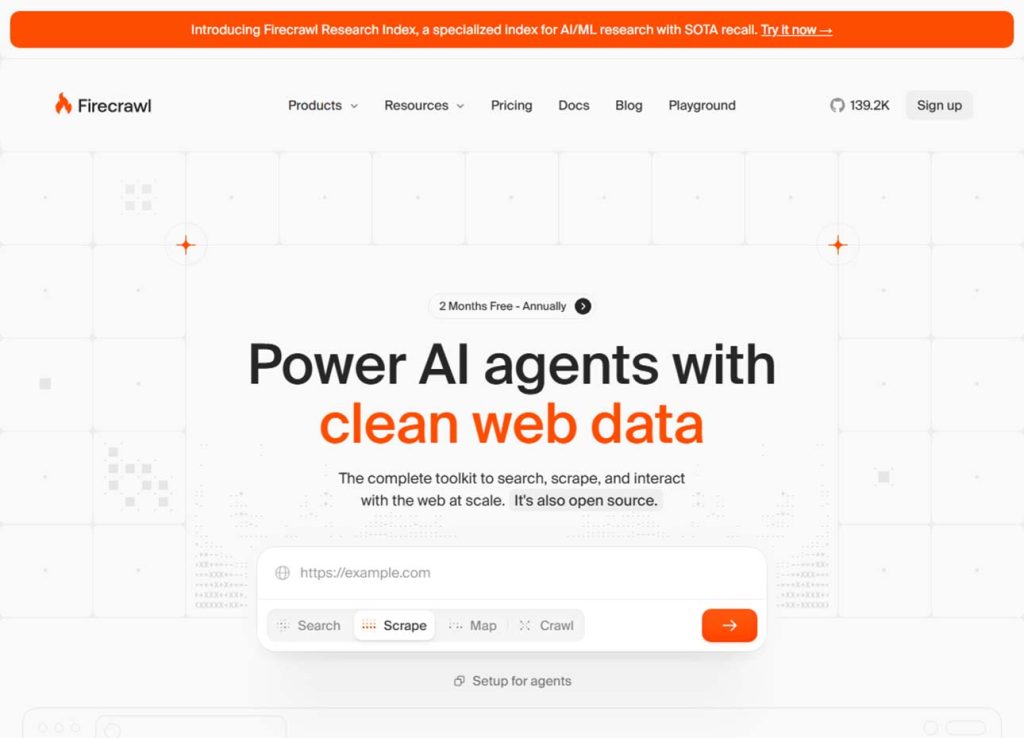
Firecrawl positions itself not merely as a scraping interface, but as a solution that addresses the entire web data acquisition workflow for teams. It handles complex web page access, content extraction, and data transformation, providing developers with information that is better suited for AI consumption.
This is crucial for teams developing RAG systems or AI agents, as the ultimate goal is not merely to store raw HTML, but to enable AI to comprehend the page content.
If the data collection phase requires extensive manual cleaning, the entire AI workflow suffers. Firecrawl minimizes these intermediate steps, allowing web content to move quickly into downstream processes.
Managed APIs Solve the Stability Issues That Plague Enterprises
In an enterprise setting, stability often outweighs raw scraping capability. If a product relies on daily large-scale data collection, frequent scraping failures can disrupt the entire business process.
For instance, AI knowledge bases might fail to update in a timely manner, competitive analysis data could be incomplete, or automated agents might miss the latest information. The value of Firecrawl’s managed service lies in handling these infrastructure challenges for the team.
This includes automatic handling of access failures, ensuring stable task execution, and maintaining the overall scraping workflow.
Teams do not need to worry about daily updates to underlying crawler frameworks or dedicate developers to troubleshooting various exceptions. For SMEs, this approach is generally more cost-effective than maintaining a complete system in-house.
Cloud-Hosted and Self-Hosted Options Meet Diverse Enterprise Needs
When selecting a technical solution, I have found that teams at different stages have vastly different requirements. For startups and small development teams, rapid product validation is paramount.
In this context, Firecrawl’s cloud service is an ideal fit. It eliminates the need to set up server environments or allocate extra personnel for infrastructure maintenance. Teams can start testing immediately, dedicating more time to product development and user validation.
Conversely, for large enterprises or industries dealing with sensitive data, self-hosting (private deployment) may be the preferred choice.
Enterprises that wish to keep data entirely within their own environment can opt for the open-source deployment solution and customize it to meet their specific security requirements. This flexibility ensures that teams of all sizes can find a deployment method that suits their needs.
Cost Comparison: Building Your Own Crawler vs. Using Firecrawl
When choosing a solution, many teams consider only the upfront development costs.
They might think, “We can just write our own crawler; it only requires a few developers.” However, long-term operation involves many additional factors. Consider a project requiring large-scale web data processing: a self-built solution entails investments in development time, server resources, proxy fees, maintenance staff, troubleshooting, and technical upgrades. These costs tend to rise continuously as the business grows.
In contrast, managed services like Firecrawl offer greater cost transparency. Teams can select plans based on actual usage, eliminating the need for heavy upfront investment in infrastructure.
For small and medium-sized teams, the biggest advantage of this model is transforming fixed costs into controllable operational expenses.
In the AI era, data acquisition capabilities are becoming a form of infrastructure
In the past, many companies viewed web scraping merely as a supplementary tool. However, with the rise of AI applications, I believe this perspective is shifting.
Many modern products now require real-time data: AI customer service agents need to read the latest documentation; research agents need to access industry insights; enterprise assistants need to sync internal materials; and automation systems require continuous web access.
Data acquisition has become a critical foundational capability for AI products.
If the data pipeline is unstable, even the most powerful AI models cannot deliver their full value. Therefore, when selecting a technical approach, I increasingly focus on a key question: Should the team maintain these underlying capabilities themselves, or should they leverage mature services and dedicate their resources to core business activities?
For most small and medium-sized teams, investing limited engineering resources in product innovation is far more valuable than reinventing the wheel by building infrastructure from scratch.
Enterprise-grade applications prioritize stability and long-term efficiency
In real-world projects, I’ve found that technical teams often overlook one critical factor: maintenance costs. Just because a solution works on day one doesn’t mean it is suitable for long-term use.
A truly mature technical choice must account for maintenance costs six months down the line, scalability as the business grows, and the ease of handovers when team personnel changes.
Firecrawl’s value lies not just in scraping web pages, but in alleviating the long-term maintenance burden on the team.
This is crucial for startups with limited budgets, rapidly growing SaaS teams, and enterprises looking to deploy AI projects quickly.
Devote time to AI products, not scraping maintenance
After working on multiple projects, I am increasingly convinced that what most teams really need isn’t to become scraping experts, but simply to possess reliable data acquisition capabilities.
While building custom scrapers still holds value in specific scenarios, managed services are generally more efficient for teams aiming to develop AI applications quickly.
Firecrawl has helped me eliminate the repetitive work involved in web data acquisition, allowing my team to focus on what truly matters.