
Setting Up a Large-Scale Modded Server for 100+ Players: A Comprehensive Guide to Shockbyte’s High-End Plans and Optimization
To be honest, when I first started hosting multiplayer game servers, I never imagined that supporting “100 concurrent players” would become a realistic requirement.
It began with just a few friends playing together, then grew into a small circle, and eventually evolved into a long-term server resembling a club or guild. It wasn’t until we hosted a special event server and tried pushing the player count past 30 for the first time that I truly realized a critical issue: the actual capacity limits of standard servers are far lower than one might imagine.
Lag, frame drops, skyrocketing latency, and even outright server crashes—these weren’t just occasional hiccups; they were inevitable consequences the moment the player count rose.
It was at this stage that I began exploring Shockbyte’s high-end hosting solutions and seriously considered what level of server support would actually be required to run a “long-term modded server for 100 players.”
I. The Breaking Point at 30 Players: Realizing “Scale” is a Critical Threshold
Initially, we ran a standard modded survival server. The content wasn’t complex—just basic survival mechanics paired with lightweight mods, such as resource expansions, tool enhancements, and minor world-generation optimizations.
Everything ran smoothly when there were fewer than 10 players.
However, problems began to surface once the player count consistently exceeded 20.
The most noticeable issue was slow chunk loading. Players exploring the map frequently encountered “delayed terrain generation,” sometimes even getting stuck in mid-air while waiting for the terrain to load.
By the time we hit around 30 players, the issues became systemic.
Redstone contraptions in survival zones impacted the server-wide TPS (Ticks Per Second), combat mods suffered from latency-induced detection errors, and even simple movements resulted in a slight “rubber-banding” or drifting sensation.
That was when I realized: the server wasn’t unplayable, but it had reached its load-bearing limit.
II. The Turning Point: Why I Considered Shockbyte’s High-End Plans
After experiencing several crashes on our event servers, I began seriously researching higher-performance hosting solutions.
What caught my eye was Shockbyte’s range of high-end plans—specifically, their high-performance solutions designed for large-scale modded servers. Unlike the low-end plans, the core difference with the high-end package isn’t just “more features”; it involves a completely different tier of resources—including more RAM, more powerful CPU allocation, more stable bandwidth, and an environment better suited for large-scale, long-term operation.
For me, the significance of this step was straightforward: it wasn’t about making the server faster, but ensuring it wouldn’t crash easily.

III. First impressions after the upgrade: From “on the verge of stuttering” to “sustainable operation”
After migrating to the high-end plan, my most immediate impression wasn’t that things were “faster,” but that the “zone of stability” had expanded.
Previously, the server would start to fluctuate the moment the player count slightly exceeded the limit; now, even as the number of online players continues to rise, it doesn’t immediately spiral into a crash.
The difference is most noticeable in the experience of running a modded server.
Load times for large modpacks have dropped significantly, and players no longer get stuck on the loading screen when entering the world. When multiple areas are active simultaneously, the drop in TPS (Ticks Per Second) is much more gradual, preventing the sudden “server-wide freeze” that used to occur.
Even during a stress test with a hundred players, the server remained in a playable state—something completely impossible in the low-end environment.
IV. Backend optimization settings: Core details that truly impact stability
While using the Shockbyte high-end plan, I discovered that stability depends on more than just hardware; backend configuration plays a crucial role.
Take memory allocation, for example: if it isn’t handled correctly, even a high-end server can suffer from wasted resources or momentary stuttering.
I adjusted the setup to dynamically allocate memory based on mod complexity and separated the load between the Overworld and instance worlds, rather than cramming everything into a single runtime space.
Another key factor is the automated backup mechanism.
For large modded servers, the cost of recovering from a crash is immense; a corrupted world could mean losing dozens of hours—or even days—of progress. Consequently, I set up more frequent backups to ensure a record exists for every critical state.
Upgraded DDoS protection is also vital. For popular servers, this is essential because the risk of external attacks rises alongside the player count.
V. Real-world testing with 100 players: The true difference shows during “peak hours”
The best illustration of this was a stress test we conducted with 100 players.
At the time, nearly 100 players were online simultaneously, engaging in activities that included modded combat, resource gathering, team-based PvP, and large-scale construction projects. In a low-spec environment, a crash is virtually inevitable under these conditions.
However, with the high-spec setup, while the server experiences minor fluctuations, it remains operational overall.
Combat mechanics remain stable, there is no noticeable lag in building synchronization, and loading large areas does not result in the game freezing completely.
More importantly, there were no catastrophic “server-wide disconnects.”
For a multiplayer community server, this factor is actually more important than raw speed.
VI. The Difference Between “Running” and “Long-Term Operation”
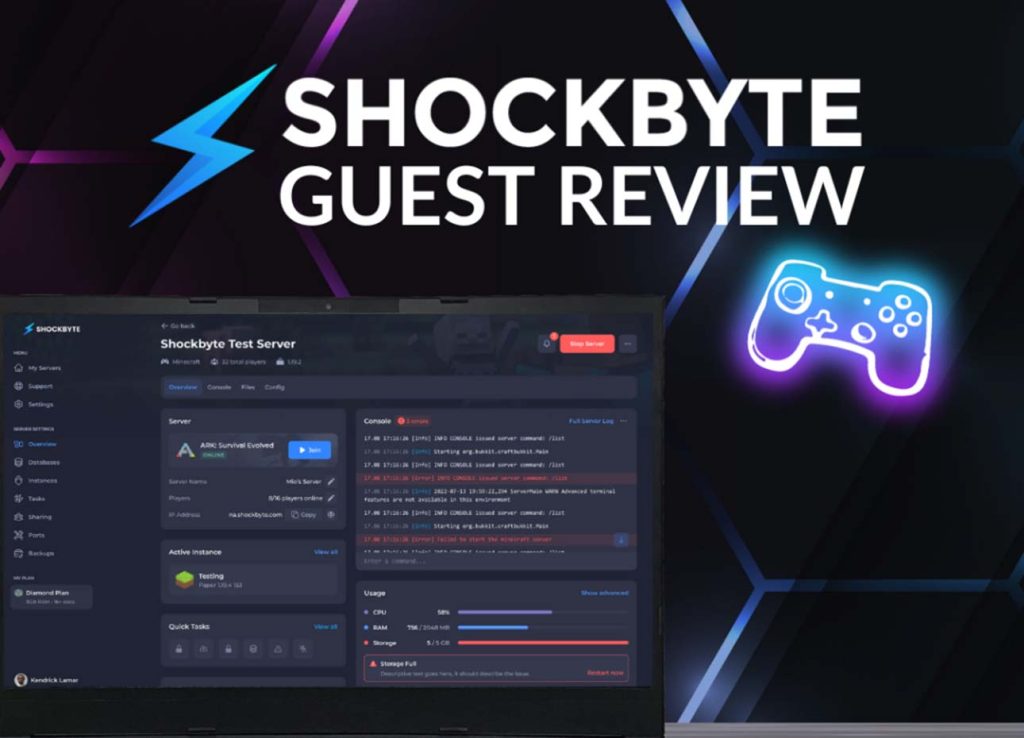
After completing this round of upgrades, my perspective on the server changed.
A low-spec server addresses the question of whether the server can simply launch, whereas a high-spec setup addresses whether it can maintain stable, long-term operation.
Once the player count reaches a certain scale, the issue shifts from single-point performance to system stability.
My impression of Shockbyte’s high-spec plan is that it doesn’t just optimize the experience of a single session; it extends the server’s overall lifespan.
The Core of a 100-Player Server Is the Limit of Stability, Not Raw Performance
Looking back at the entire process, my main takeaway is simple. From the initial small server for 10 players to the laggy 30-player phase, and finally to stable operation with nearly 100 players, the true determinant of the experience wasn’t the complexity of the gameplay, but the server’s ability to withstand fluctuations.
The value of the high-spec setup lies in how significantly it pushes back that “crash threshold.” For anyone looking to host guild servers, community servers, or long-term multiplayer modded servers, this stability is the core value proposition.